De acordo com a Pesquisa Nacional sobre Aborto de 2016 do Brasil, o aborto é uma prática comum, e o método mais utilizado para realizar um aborto é o Misoprostol, um medicamento recomendado pela Organização Mundial da Saúde para abortos seguros. Embora a hospitalização seja às vezes necessária para completar o aborto, este número está diminuindo, sugerindo que, apesar das restrições legais e da repressão, as mulheres estão usando cada vez mais métodos mais seguros para realizar um aborto.
Leis e regulamentações
A lei do aborto no Brasil
Provocar aborto em si mesma ou consentir que outrem lhe provoque:
CP – DECRETO LEI N° 2.848 DE 07 DEZEMBRO DE 1940: ARTIGO 124
Pena — detenção, de um a três anos.
O aborto induzido no Brasil ainda é criminalizado, e punido com penas de 1 a 3 anos de prisão para a mulher grávida e de 1 a 4 anos para o médico ou qualquer outra pessoa que efetue o procedimento de interrupção da gravidez. Essa previsão legal está em vigor desde 1940 1 e pode ser encontrada no art. 124 do Código Penal.
Exceções legais à penalização após um aborto no Brasil
Existem apenas três casos onde uma pessoa pode conseguir acesso aos serviços abortivos sem punição (art. 124-127):
Decreto Lei n° 2.848 de 07 Dezembro de 1940: Artigo 124 – 127
Números e dados
Quantos abortos são feitos no Brasil?
AbortionData.org estimates that at least 525,132 abortions likely occurred in Brazil in 2025. This projection is based on applying the annual abortion rate, as determined by Brazil’s National Abortion Survey (PNA), to the country’s projected population.
How we calculate the estimate
The core of the AbortionData.org estimate relies on data from the PNA 2015 survey, which provided an annual abortion rate2. Here’s a breakdown of the methodology:
- Starting point: PNA 2015 study estimated around 503,000 abortions for women aged 18-39.
- Projecting to 2025: To estimate the number of abortions for 2025, this annual rate is applied to the projected total population of Brazil for 2025. Official figures from the IBGE estimate Brazil’s population to reach 213.4 million in 2025, with a growth rate of 4.4% between 2015 and 202534.
- The new estimate: Both data sources are then combined to arrive at 525,132 abortions in 2025: 503.000×1,044≈ 525.132
Navigating the Numbers: Understanding Abortion Trends in Brazil
The latest National Abortion Survey from 2021 presents a nuanced picture of abortion trends5: by the age of 40, one in seven women in Brazil has undergone an abortion.
While this so called lifetime prevalence of abortion (the proportion of women who have ever had an abortion) has seen a notable decline, falling from 15% in 2010 to 13% in 2016, and further to 10% in 2021, the estimated total number of abortions is most likely increasing mainly due to population growth.
Even as the percentage of women undergoing abortions decreases, Brazil’s overall population, particularly the female population within reproductive age groups (18-39 years), continues to grow. If the population continues to expand, the absolute number of abortions should remain high or even rise, despite a lower rate per woman.
Furthermore, the PNA 2021 highlighted that half of women who have abortions had their first one as adolescents (19 or younger), indicating that younger demographics are significantly impacted, but not entirely covered by the mentioned researches.
Understanding the Reality: Why Official Numbers Don’t Tell the Whole Story
Our estimate relies mostly on academic reports and inofficial data sources, because governmental statistics capture only a fraction of the reality of abortions in Brazil. Many abortions occur outside the formal health system and are documented only when complications arise. This data gap is starkly visible when analyzing statistics from Brazil’s public health system.
In the first half of 2020, Brazil’s public health system (SUS) officially registered only 1,024 legal abortions nationwide. In the same period, however, it treated approximately 80,948 cases of complications from unsafe or incomplete abortions (news agency G1). Similarly for the entire year of 2021, data showed that for every single legal abortion performed in the SUS, there were eleven emergency treatments for complications from unsafe abortions or miscarriages6.
There is no data on unsafe abortion in the Brazilian information health systems. The official databases do not enable estimates of the number of abortions in Brazil. The available data are restricted to deaths from abortion and hospitalizations due to complications from abortion in the public health system.
Abortion in Brazil: what do the official data say? (Cardoso et al., 2020)7
Restrictions do not prevent but lead to more insecure abortions
This discrepancy is a well-documented issue, rooted in the legal and social context of the country. Academic reports show significant “challenges to research within a context of illegality,” confirming that the criminalized status of abortion makes accurate official data collection nearly impossible8.
Anyhow, research has shown that abortion is a common experience in the reproductive lives of women and girls in Brazil, even where the procedure is legally restricted. Legal barriers may not prevent women from deciding to have an abortion, but the data make clear that they significantly limit access to safe and legal abortion care, especially for black and indigenous women.
According to the 2016 National Abortion Survey, 48% of valid responses about women’s most recent abortion indicated that it was carried out using medication; while the survey did not ask which specific drug was used, the report notes that misoprostol (Cytotec®) is the main abortion medication circulating in Brazil and is therefore likely to account for a substantial share of these cases.
Opinião pública
O que os Brasileiros acreditam
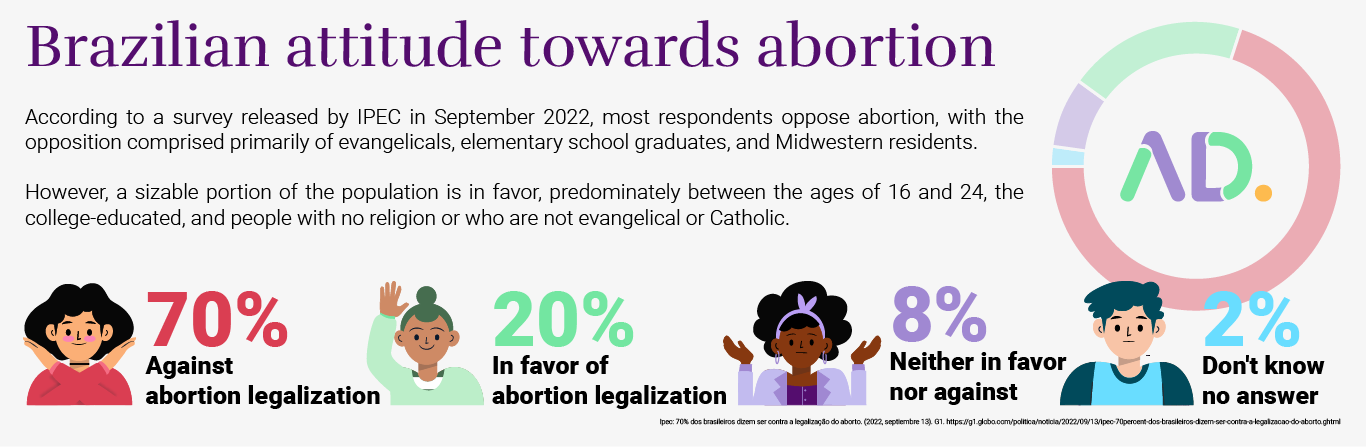
Uma pesquisa IPEC de setembro de 2022 mostra: 70% dos brasileiros são contra a legalização do aborto, 20% a favor. A oposição é particularmente comum entre evangélicos, pessoas com apenas ensino fundamental e moradores do Centro-Oeste. Os apoiadores são principalmente jovens de 16-24 anos, universitários e sem filiação religiosa (nem evangélicos nem católicos).
Solicitantes de aborto
Who are the people who have requested legal abortions?
An independent study conducted by social scientists Debora Diniz and Marcelo Madeiro offers valuable demographic insights into women seeking legal abortions. This research stands out as one of the most comprehensive analyses of the demographic profiles of abortion seekers in Brazil 9.
Between 2013 and 2015, the study analyzed 1,283 medical records of women who had legal abortions at five services across five regions. This provided an estimate of the number and demographic profile of abortion seekers nationwide.

The research is based on public health service reports. For better data on who seeks and accesses legal abortion services, up-to-date statistics and a comprehensive registry would be required 10.
Parcela preocupante de crianças e adolescentes
O estudo demonstrou uma parcela preocupante de abortos legais envolvendo menores de idade, e não apenas pessoas adultas. Cerca de um em cada cinco casos envolveu pessoas com menos de 18 anos, e quase um em cada dez abortos foi realizado em uma criança de 12 a 15 anos. No Brasil, a violência sexual contra crianças é amplamente disseminada. Por isso, é importante enfatizar tanto o direito das meninas de acessar serviços legais de aborto quanto a necessidade de uma resposta do Estado que proteja efetivamente suas vidas.
Distorção racial nos dados oficiais sobre aborto
Diniz e Medeiros também observaram que a maioria das pessoas que acessam serviços legais de aborto é branca. No entanto, a jornalista da revista Azmina, Greice Menezes, argumenta que mulheres negras estão sub-representadas no acesso legal devido ao racismo institucional. Isso é corroborado por dados do Instituto Brasileiro de Geografia e Estatística (IBGE), que mostram que mulheres negras passam por o dobro de abortos inseguros em comparação com mulheres brancas. 11.
Acessibilidade e Métodos
How people can get an abortion in Brazil
Legal abortion services in Brazil are mainly available in public hospitals and a limited number of specialized services, and their geographic coverage is very restricted. These legal services are concentrated in relatively few municipalities and large urban centers, leaving many regions without any providers, so people often have to travel long distances and across multiple municipalities to reach a facility that will actually provide legal care.
How to obtain a legal abortion in Brazil
If the pregnancy fits one of the legal exceptions, the person should seek care at a hospital, public health service, or clinic that provides legal abortion care.
For pregnancy following sexual violence, survivors may seek care at designated public hospitals and sexual violence referral centers. Available services can include emergency contraception, STI prophylaxis, forensic care, and, when requested by the survivor and permitted by law, termination of pregnancy.
Health services are legally required to provide this care and should not require a police report in order to treat survivors or provide an abortion; however, in practice, many survivors still face serious barriers when trying to access these services.
If the pregnancy involves a risk to the pregnant person’s life or fetal anencephaly, the path also leads to a hospital or public clinic. In these situations, clinicians can provide a termination when there is a medical indication, usually after some confirmation steps and medical evaluations, with the focus on the person’s health, safety, and informed consent.
Legal telemedicine in cases of sexual violance
In Brazil, telemedicine abortion is provided by the Núcleo de Atenção Integral a Vítimas de Agressão Sexual (Nuavidas) in the Hospital de Clínicas in Uberlândia. The service is intended as a solution to isolation and lockdown in cases of sexual violence.
The services reported that, as of April 2021, 15 women had terminated their pregnancies using their services 12. If these figures are accurate, they suggest that the available legal services are used by only a small fraction of those in need, since, given the reported levels of sexual violence, one would expect a much higher number of abortions.
Administrative and practical requirements
Officially, abortion care for eligible cases should be provided free of charge within the public health system (SUS). To obtain a legal abortion, the pregnancy must fit one of the legal grounds (risk to life, pregnancy following sexual violence, or fetal anencephaly), and services commonly require medical evaluation, ultrasound or clinical confirmation of gestational age, and signed informed consent, sometimes with additional psychosocial assessment.
In practice, administrative, bureaucratic, and provider-level barriers (few trained or willing providers, a limited number of facilities, local interpretations of the law, and in some places informal demands for documents such as police reports) can delay or block access. Informal or private providers may offer services, but access, cost, and safety vary, and legal clinics remain few in number and unevenly distributed across the country.
Legal abortion methods in Brazil
In Brazil, only a limited set of methods is legally available for ending a pregnancy. These include the use of abortion pills such as misoprostol under medical supervision, as well as in‑clinic procedures provided in authorized health services.
Abortion with pills (Misoprostol)
Misoprostol is a registered medication in Brazil and is used in hospitals to provide safe, legally permitted abortion care and to support the medical management of pregnancy, including induction of labor and treatment when a pregnancy has already ended but tissue remains in the uterus.
Abortos em clínicas
Aspiração Manual a Vácuo
A Aspiração Manual por Vácuo está disponível nos centros médicos para interromper legalmente as gravidezes até às 14 semanas.
Aspiração a Vácuo Elétrica
A aspiração de vácuo eléctrica está disponível em algumas partes do país. Os registos indicam que 3% dos abortos legais foram realizados com este método 13.
Abortion access in Brazil outside the legal services
Legal restrictions surrounding abortion create barriers to accessing safe abortion methods. In Brazil, people who require an abortion often have to seek private clinics that offer the service clandestinely, buy mifepristone and/or misoprostol on the informal market, or use traditional folk methods that are not recognized by the World Health Organization (WHO).
Because abortion pills cannot be obtained over the counter in pharmacies, many people obtain misoprostol through informal vendors and street markets, through contacts who resell pills, or by searching online and buying from unregulated websites or international feminist telehealth organizations. These routes are often expensive, legally risky, and may involve counterfeit or substandard medications, especially for those with fewer financial resources.
Self-Management of Misoprostol vaginally and orally
Misoprostol (marketed in Brazil as Cytotec) is central to abortion care carried out outside Brazil’s formal legal system. Qualitative interviews from the National Abortion Survey interviews (2010–11) in five state capitals found that the prevailing induction practice among women who reported illegal abortions was a mix of herbal teas and misoprostol, with many women later seeking hospital assistance after initiating the process14.
Earlier hospital‑based data from Fortaleza (1992–93) similarly documented extensive use of misoprostol: two‑thirds (66%) of women admitted for complications after an induced abortion reported using misoprostol (median reported dose four tablets, most taken both orally and vaginally)15.
Taken together, these sources point to widespread self‑managed, medication‑based abortions in Brazil, many of which result in later contact with health services but many others likely remain entirely outside the clinical system. At the same time, both types of studies (non‑probability interview samples and hospital‑based case series) have important methodological limits, so they cannot accurately measure the number of uncomplicated abortions that never reach a hospital or legally verify each individual case.
Legal abortion by telemedicine in remote regions
A telemedicina é uma maneira eficaz e segura de fazer abortos com Misoprostol e Mifepristone 16. Some international organizations offer these services to women that live in restrictive settings. In 2015, approximately 416,000 women had an abortion, and 48% of the cases, had abortions with Misoprostol pills 17.
Telemedicina pelo Women on Web
El sitio web Women on Web, que ofrece servicios de telemedicina en todo el mundo, ha publicado en su página web 1.086 historias de mujeres brasileñas que han hecho un aborto seguro con pastillas.
Accessability issues force abortion seekers to travel
According to the SUS’s Norma Técnica: Humanized Abortion, it is the State’s responsibility to provide abortion services in public hospitals, within the legal exceptions. However, access to this right is not always guaranteed and even people who meet the legal criteria often face serious barriers to accessing services, from geographical distance and lack of trained providers to stigma and institutional resistance.
According to a research conducted by Azmina and Gênero e Número, 13 states do not have a clinic that offer legal abortions, causing many women to travel to the nearest city to obtain abortion services.

Because services are scarce and geographically concentrated, people often face long delays and must travel between facilities, which increases the risk of complications and late presentation.
Even though travelling for abortion is not a new practice in Brazil 18, their data indicates that travelling is an effective alternative to unsafe abortion methods. However, it is an alternative that involves risks, expenses, emotional burdens, stigma, shame, time consumed, and familiar negotiations 19. Furthermore, not all individuals can afford this alternative or can afford to take a few days off to travel.
Milhas Pela Vida das Mulheres
Milhas Pela Vidas Mulheres is a non-profit organization that provides information and financial assistance to women seeking abortion services. In addition, they work to ensure access to safe abortion for the more vulnerable women. Thus, black and peripheral women are privileged to receive their support. Their help could be information and financial assistance to travel to another city inside Brazil to access the services or, in some cases, travel abroad of the country to access abortion services.
According to this organization, 70% of the women who require abortion services are unaware that they have the right to access legal assistance as their situations are contemplated within the permitted exceptions.
Há necessidade de uma pesquisa mais detalhada para entender a experiência de viajar para abortar. Para aqueles que procuram abortos, é essencial estudar as barreiras logísticas, o custo e a carga emocional que esta experiência representa.
Further accessability issues in times of crisis
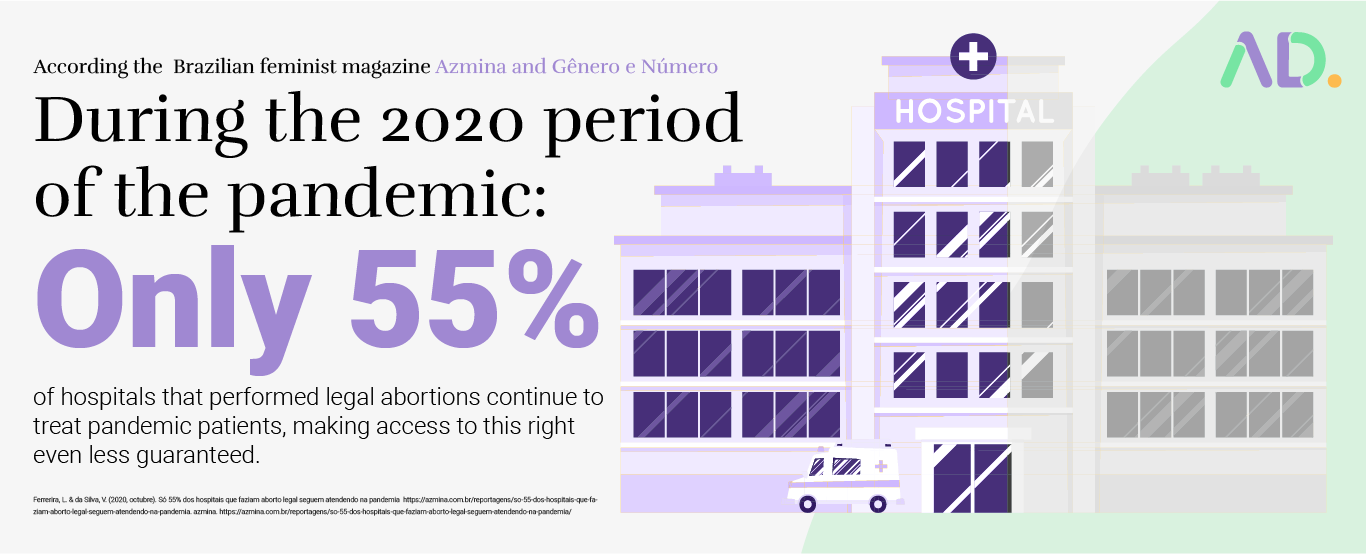
Although Brazilian abortion law guarantees a legal right to abortion in three situations, data from the Brazilian feminist magazine AzMina from October 2020 show that during the pandemic numerous hospitals stopped performing legal abortions, making clear how quickly this right is effectively undermined in times of crisis.
During health emergencies (e.g., COVID-19, Zika) and periods of political pressure, services can be further disrupted, magnifying access problems.
Cultural context
Abortions in Brazils social environment
There is a determining relationship between abortion and cultural conditions in Brazil. Women live in a state of socioeconomic inequality that translates into factors such as less access to education, decent housing, and contraceptive methods, among others. In addition, structural racism, which places black women under greater vulnerability, makes the situation even worse. In this way, cultural, social, and economic conditions lead to a lack of access to the public health system, generating more significant risks of unsafe abortion 20.

What we don't know
The Brazilian Data Gap
Although the SUS collects general data about abortion within the health system, much important information is only delivered thanks to NGOs (non-governmental organizations). However, to draw a complete picture of the abortion situation in Brazil, studies would require answering the following questions.
*This page presents abortion data only for women and girls since the information available is usually not separated by gender. However, AbortionData.org reconoce esta limitación.
Fontes
Fontes
- Hardy, E., & Rebello, I. (1996). La discusión sobre el aborto provocado en el Congreso Nacional Brasileño: el papel del movimiento de mujeres. Cadernos de Saúde Pública, 12, 259-266.
↩︎ - Diniz, D., Medeiros, M., Madeiro, A., 2017. Pesquisa Nacional de Aborto 2016. Ciênc. Saúde Coletiva 22, 653–660. https://doi.org/10.1590/1413-81232017222.23812016
↩︎ - IBGE Diretoria de Pesquisas, Coordenação de População e Indicadores Sociais, População residente enviada ao Tribunal de Contas da União
Brasil, Grandes Regiões e Unidades da Federação ‐ 2001‐2015, https://ftp.ibge.gov.br/Estimativas_de_Populacao/Estimativas_2015/serie_2001_2015_TCU.pdf ↩︎ - IBGE. Diretoria de Pesquisas – DPE – Coordenação de População e Indicadores Sociais – COPIS, ESTIMATIVAS DA POPULAÇÃO RESIDENTE NO BRASIL E UNIDADES DA FEDERAÇÃO COM
DATA DE REFERÊNCIA EM 1º DE JULHO DE 2025, https://ftp.ibge.gov.br/Estimativas_de_Populacao/Estimativas_2025/estimativa_dou_2025.pdf ↩︎ - Diniz, Debora, et al. “National Abortion Survey – Brazil, 2021.” Ciência & Saúde Coletiva, vol. 28, no. 6, FapUNIFESP (SciELO), June 2023, pp. 1601–1606. Logically, doi:10.1590/1413-81232023286.01892023. ↩︎
- Folha de S. Paulo (2022), A cada aborto legal, 11 meninas são internadas por interrupções provocadas ou espontâneas ↩︎
- B. B. Cardoso et al., Cadernos de Saúde Pública 36 (Suppl 1), 2020, https://doi.org/10.1590/01002-311X00188718 ↩︎
- Menezes, S., Aquino, E.M., Fonseca, S.C., & Domingues, R. (2019). Abortion and health in Brazil: challenges to research within a context of illegality. https://www.scielo.br/j/csp/a/C5N3RmP8TySscVPpqx5B4Vf/?format=pdf&lang=en ↩︎
- Madeiro, A.P., Diniz, D., 2016. Serviços de aborto legal no Brasil – um estudo nacional. Ciênc. Saúde Coletiva 21, 563–572.
https://doi.org/10.1590/1413-81232015212.10352015
↩︎ - IDEM
↩︎ - Folego, T. (2017) “Criminalização do aborto mata mais mulheres negras”. Revista Azmina https://azmina.com.br/reportagens/precisamos-falar-de-aborto-e-como-ele-mata-mulheres-negras Jan, 28 2022.
↩︎ - Acento (2021) El aborto legal por telemedicina se abre paso en Brasil. Acento https://acento.com.do/actualidad/el-aborto-legal-por-telemedicina-se-abre-paso-en-brasil-8938183.html
↩︎ - Diniz, D., Medeiros, M. (2012) Itineraries and methods of illegal abortion in five Brazilian state capitals Ciência & Saúde Coletiva, 17(7):1671-1681.
↩︎ - IDEM ↩︎
- Fonseca, W., Misago, C., Correia, L. L., Parente, J. A., & Oliveira, F. C. (1996). Determinantes do aborto provocado entre mulheres admitidas em hospitais em localidade da região Nordeste do Brasil. Revista de Saúde Pública, 30(1), 13-18.
↩︎ - Aiken, A., Lohr, P. A., Lord, J., Ghosh, N., & Starling, J. (2021). Effectiveness, safety and acceptability of no-test medical abortion (termination of pregnancy) provided via telemedicine: a national cohort study. BJOG : an international journal of obstetrics and gynaecology, 128(9), 1464–1474.
https://doi.org/10.1111/1471-0528.16668
↩︎ - Diniz, D., Medeiros, M., Madeiro, A., Universidade de Brasília, Brasil, Universidade de Brasília, Brasil, Universidade Estadual do Piauí, Brasil, 2017. Pesquisa Nacional de Aborto 2016. Ciênc. Saúde Coletiva 22, 653–660.
https://doi.org/10.1590/1413-81232017222.23812016
↩︎ - Sethna, C., & Davis, G. (Eds.). (2019). Abortion across borders: Transnational travel and access to abortion services. JHU Press.
↩︎ - Murray, L., & Khan, N. (2020). The im/mobilities of ‘sometimes-migrating’for abortion: Ireland to Great Britain. Mobilities, 15(2), 161-172.
↩︎ - Fusco, C. L., & Andreoni, S. (2012). Unsafe abortion: social determinants and health inequities in a vulnerable population in São Paulo, Brazil. Cadernos de Saúde Pública, 28, 709-719. ↩︎
- CLACAI (2017) Mifepristona y misoprostol en seis paises de America Latina.
- Departamento de Saúde Comunitária, Universidade Federal do Ceará. Fortaleza, CE – Brasil (W.F., L.L.C.); Maternal and Child Epidemiology Unit. London School of Higiene and Tropical Medicine, UK (C.M.); Hospital Geral César Cals. Fortaleza, CE – Brasil (J.A.M.P.); Maternidade Escola Assis Chateaubriand da Universidade Federal do Ceará. Fortaleza, CE – Brasil.
- Key Facts on Abortion, n.d. . Amnesty Int.
https://www.amnesty.org/en/what-we-do/sexual-and-reproductive-rights/abortion-facts
- Freitas, J. E. P. D., 2020. Abortion Is A Fundamental Right—Brazil Is Failing To Fully Recognise It. Human Rights Pulse, 19 Septiembre.